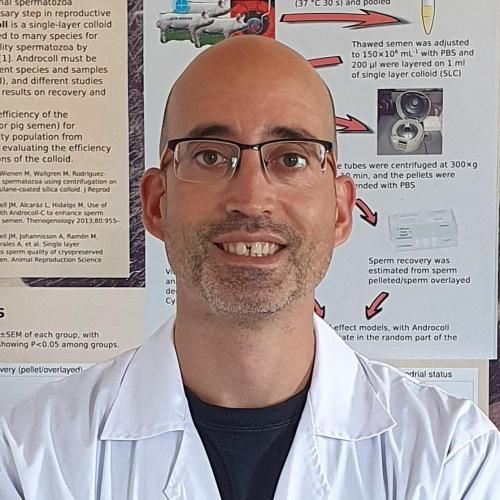
FELIPE
MARTÍNEZ PASTOR
Catedrático de Universidad
Department: BIOLOGÍA MOLECULAR
Center: FACULTAD DE CC BIOLÓGICAS Y AMBIENTALES
Universidad: University of León
Area: Cell Biology
Research group: IMAPOR REPRODUCCIÓN ANIMAL
Email: felipe.martinez@unileon.es
Personal web: http://reprobio.unileon.es
Disponible para contactar con medios ( prensa / radio / tv )


Doctor by the Universidad de León with the thesis Obtención postmortem y calidad de los espermatozoides de la cola del epidídimo del ciervo rojo ibérico (cervus elaphus hispanicus) 2004. Supervised by Dr. María Paz Herráez Ortega, Dr. Luis Anel Rodríguez, Dr. Paulino de Paz Cabello.
Full Professor in the Dept. of Molecular Biology at the University of León. Sperm biology researcher since 1999. Co-author of 135 SCI articles (principal author on 56), 90 in Q1, 9 book chapters, and 260 conference presentations. Principal Investigator of 3 national and 4 regional projects, and participant in 14 more; principal investigator of 7 R&D contracts, and participant in 10 more. H-index 45 (Scopus), 56 (Google Scholar), >4570 cumulative citations (>7350 in Google Scholar). Bachelor of Science in Biology from the University of León (1999, with Extraordinary End-of-Degree and Bachelor's Degree Awards). PhD thesis as a FPU (MCyT) grant recipient, 5 SCI publications. Participated in research lines on sheep and brown bear reproduction, contributing to the group thanks to his expertise in data analysis and flow cytometry (currently recognized). Research stays at the University of Zaragoza (2000), the Swedish University of Agricultural Sciences (Uppsala, Sweden, 2002), and the Wildlife Biological Resource Centre (South Africa, 2003). During this period, he published 14 articles (first author on 8) and presented 45 papers. In 2005, he was awarded a Juan de la Cierva grant (University of Castilla-La Mancha/IREC, Dr. J. Garde). His main research focus was the study of oxidative stress in deer spermatozoa. He was the principal investigator of a project funded by the Regional Government of Castilla-La Mancha. He collaborated on other research lines (AI in deer, sheep and cattle reproduction) and on two other research projects. He initiated international collaborations, including at the Univ. of Algarve (Portugal) on teleost reproduction, and undertook four research stays (2005-2007), supported by an Integrated Action. Between 2007 and 2008, he undertook research stays at the Chicago Zoological Society (USA) on the influence of captive breeding strategies on sperm quality. These stays resulted in publications (24 SCI articles, 12 as lead author) and contributions to conferences. He also completed research stays at the University of Murcia (Spain, 2006) and the Institute of Animal Reproduction and Food Research (Poland, 2007). During this period, in 2008 he obtained a Ramón y Cajal contract, joining the Institute for Livestock Development and Animal Health at the University of León (ULE) (2009) as an independent researcher (14 SCI articles without thesis advisors, 26 with postdoc advisors). He established his laboratory at INDEGSAL, supervising more than 30 undergraduate students, 14 master's students, and 8 doctoral candidates (5 theses defended). He has hosted 12 students from other research groups, 5 of whom were international. At this stage, he is the Principal Investigator of a project funded by the National Plan and another funded by the Regional Government of Castile and León. He holds 4 patents and coordinates 9 contracts. He has been invited to write a book chapter and two reviews (SCI journals), and has presented 4 papers at conferences, publishing 35 SCI-indexed articles. Positive evaluation of the I3 program in 2013. He has been involved in teaching in the area of Cell Biology at the University of León (ULE) for the past 17 years, participating in three Master's programs (ULE, University of Castilla-La Mancha (UCLM), and University of Oviedo). He has served on 8 doctoral dissertation committees and one master's thesis committee. He collaborates with Spanish and international research groups (5 active international and 6 active national collaborations). He is a member of scientific societies (ESDAR, SEBC, AERA, ASEBIR, ITEA). He is a reviewer for projects funded by ANEP, NKFI (Hungary), AVCR (Czech Republic), and UNMP-FCA (Argentina); and for articles in over 50 SCI journals. Member of the editorial panel of the Spanish J. of Agricultural Sciences.